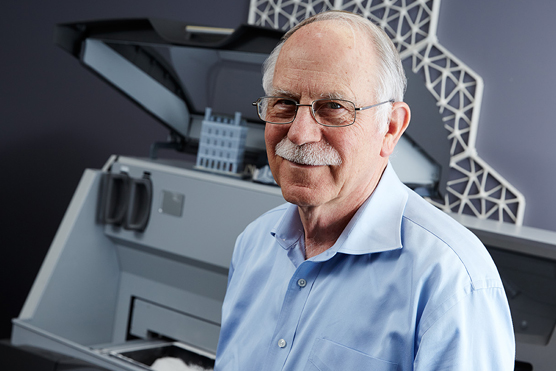
Minds Behind the Machines: Chuck Hull
Minds Behind the Machines is a series celebrating the visionary inventors and engineers whose groundbreaking innovations have transformed manufacturing and industry. From the factory floor to the executive suite, these brilliant minds have solved complex challenges, reimagined entire processes, and created technologies that continue shaping how we make everything from everyday products to space-age components. Each profile explores not just what these innovators created, but how their unique approaches to problem-solving and willingness to challenge conventional thinking led to breakthroughs that changed the world.
Chuck Hull (1939-present) fundamentally changed manufacturing forever when he invented stereolithography in 1983, creating the world's first 3D printer. His revolutionary machine transformed how we think about production, prototyping, and even the nature of physical objects themselves. From aerospace components to medical implants, Hull's invention launched an entire industry that continues reshaping manufacturing across every sector.
The Birth of 3D Printing
Working as an engineer at a small company producing UV lamps, Hull grew frustrated with the lengthy process of creating prototypes for new products. Traditional manufacturing required expensive tooling and weeks of machining to produce a single test part. Hull envisioned a radically different approach: building objects layer by layer using light to solidify liquid plastic.
In 1983, Hull developed stereolithography—a process where ultraviolet lasers cure photopolymer resin into solid plastic, one microscopic layer at a time. His first successful print was a simple eyewash cup, but it proved the revolutionary concept worked. Instead of carving away material like traditional manufacturing, Hull's process added material precisely where needed, building complex geometries impossible with conventional methods.
The technical challenges were immense. Hull had to develop new photopolymer resins that would cure properly, design precise laser control systems, and create software that could slice 3D digital models into thousands of printable layers. Each component required innovation, from the chemistry of light-sensitive plastics to the mechanics of moving laser beams with micrometer precision.
Commercializing the Impossible
In 1986, Hull founded 3D Systems Corporation to commercialize his invention, introducing the SLA-1 (StereoLithography Apparatus) as the world's first commercial 3D printer. Priced at over $100,000, these early machines targeted product designers and engineers who needed rapid prototyping capabilities.
Hull understood that creating the printer was only half the challenge. He also developed the STL file format—still the standard for 3D printing today—that describes 3D objects as collections of triangular surfaces. This digital foundation enabled any 3D model to be translated into printable instructions.
The early applications were transformative for industries like automotive and aerospace, where engineers could test designs in hours rather than weeks. Companies like Ford and General Motors adopted Hull's machines to accelerate product development, reducing time-to-market for new vehicles.
Expanding the Possible
Hull continued innovating throughout the 1990s and 2000s, developing new printing technologies and materials. His team created selective laser sintering (SLS), which uses lasers to fuse powder materials, enabling printing with metals, ceramics, and advanced composites. These developments expanded 3D printing from plastic prototypes to functional end-use parts.
Medical applications proved particularly revolutionary. Surgeons began using 3D-printed models to practice complex operations, while researchers developed biocompatible materials for implants and prosthetics. Hull's technology enabled custom hearing aids, dental crowns, and even experimental organ printing.
The Digital Manufacturing Revolution
Hull's invention represents more than just a new manufacturing method—it fundamentally changed the relationship between digital design and physical objects. His technology democratized manufacturing, allowing individuals and small companies to produce complex parts without massive industrial infrastructure.
The implications continue expanding as 3D printing evolves. Aerospace companies now print lightweight components that couldn't be manufactured traditionally. Automotive manufacturers use 3D printing for custom tooling and low-volume production. Even construction companies experiment with printing entire buildings.
Legacy of Layer-by-Layer Innovation
Hull's approach to innovation—identifying fundamental limitations in existing processes and completely reimagining solutions—exemplifies transformative engineering thinking. Rather than incrementally improving traditional manufacturing, he created an entirely new paradigm based on additive rather than subtractive processes.
Today, with over 60 patents to his name, Hull continues advancing 3D printing technology. His invention has spawned countless innovations, from desktop printers costing hundreds of dollars to industrial systems producing aerospace components. The technology he pioneered in his small laboratory has fundamentally altered how humanity makes things, proving that the most revolutionary machines often emerge from completely rethinking basic assumptions about what's possible.