
Henry Ford: The Visionary Who Put the World on Wheels
How One Man Changed the Face of Transportation and Manufacturing Forever
Long before highways crisscrossed the land and cars became everyday companions, the streets echoed with horses and wooden wheels. Into this world stepped Henry Ford, a man whose passion for machines would help launch a revolution in personal transportation. One of the first “Minds Behind the Machines,” Ford’s journey took him from an inquisitive farm boy to a transformational architect of change.
Humble Beginnings on the Farm
Born on July 30, 1863, in a modest farmhouse nestled in the rural sprawl of Dearborn, Michigan, Henry Ford was the eldest of six children in a hard-working family of farmers. Life on the Ford homestead was defined by labor and resourcefulness—every member of the family had a role, and the boundaries between work and life blurred in the rhythm of the seasons. Yet even as a child, young Henry showed little interest in tilling the soil or managing livestock. Instead, he was captivated by the inner workings of machinery and the promise of technology to make tough jobs easier. He spent countless hours tinkering with his father’s tools, disassembling clocks and watches, and reconstructing them with precision. Family stories recount how neighbors would bring him broken machines, and he would repair them, sometimes improving the design in the process.
Ford’s curiosity was fueled by the changing world around him. The post-Civil War era was marked by rapid industrial growth and the slow but steady march of innovation into everyday life. Steam engines, threshing machines, and other mechanical marvels began to appear in Michigan’s countryside, sparking Ford’s imagination. At 16, eager to escape the confines of the farm, Ford walked miles to Detroit, where he found work as an apprentice machinist. These early experiences not only honed his mechanical skills but also shaped his belief that technology, if made accessible to everyone, could dramatically improve lives.
Early Experiments and First Steps in Detroit
While Detroit would later become known as the Motor City, when Ford arrived it was a growing but rough-edged town of opportunity, filled with workshops and the hum of invention. Ford threw himself into learning the trade, first at the Michigan Car Company and later at the Detroit Dry Dock Company, absorbing everything he could about engines, tools, and efficiency. His commitment and ingenuity did not go unnoticed. In 1891, he joined the Edison Illuminating Company as an engineer, a position that exposed him to the forefront of electrical innovation. The role required constant learning and problem-solving, and Ford advanced quickly, eventually becoming chief engineer.
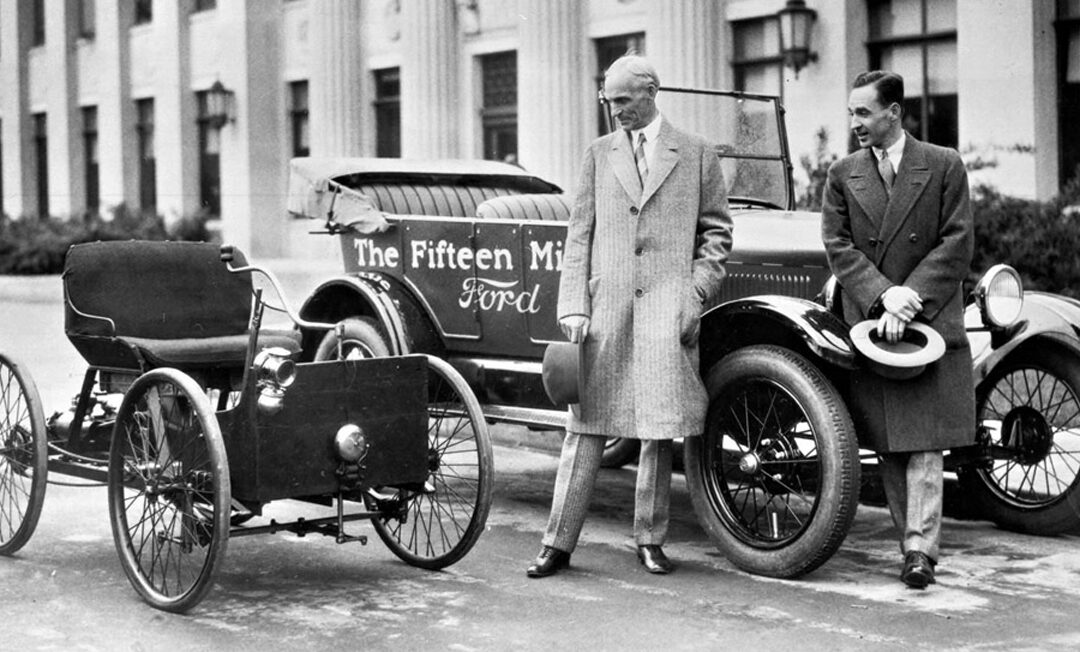
His time at Edison’s company was transformative. Inspired by Thomas Edison’s encouragement after presenting his gasoline engine ideas, Ford began working in his spare time on a gasoline-powered horseless carriage. The result, in 1896, was the “Quadricycle”—a spindly, four-wheeled contraption powered by a modest two-cylinder engine. Built in a small shed behind his home, the Quadricycle could reach speeds up to 20 miles per hour and was steered with a tiller rather than a wheel. Though humble, it was a testament to Ford’s resourcefulness and vision, and it marked his first tangible step toward revolutionizing transportation.
Founding the Ford Motor Company
Despite the invention of the Quadricycle, Ford’s early business ventures were fraught with difficulty. His first company, the Detroit Automobile Company, failed within a year due to high production costs and inconsistent quality—a frustrating setback but one that taught Ford valuable lessons about manufacturing and market needs. Refusing to give up, he launched the Henry Ford Company, but internal disputes led him to walk away before it could succeed. With each setback, Ford became more convinced that the key to success was not just building automobiles but building them efficiently and affordably.
In 1903, with a core group of investors and supporters, Ford established the Ford Motor Company. The company’s first car, the Model A, was assembled in a converted wagon factory on Mack Avenue, with parts sourced from other suppliers. In the first year, Ford sold over 1,700 Model As—a promising start that set the stage for future innovation. Unlike other automakers of the era who catered to the wealthy, Ford envisioned a car that the average working person could afford, believing that widespread mobility would have the power to reshape society itself.
The Birth of the Model T and the Age of Mass Production
The introduction of the Model T in 1908 was nothing short of revolutionary. Built to be durable enough for unpaved roads, simple enough for novice drivers, and affordable for ordinary families, the Model T epitomized Ford’s belief in “a motorcar for the great multitude.” Within months of its release, demand soared. Over the next two decades, nearly 15 million Model Ts would roll off Ford’s assembly lines, transforming the automobile from a luxury into an everyday necessity.
Ford’s real genius lay in how he made the Model T. Taking inspiration from industries such as meatpacking and flour production, he introduced the moving assembly line at the Highland Park plant in 1913. Cars under assembly traveled from station to station, with each worker responsible for a specific task. This innovation slashed assembly time from more than 12 hours to just an hour and a half. Costs plummeted, allowing Ford to continually lower the price. The efficiency of mass production not only increased profits but also made the automobile accessible to an entirely new class of Americans. By the 1920s, nearly everyone knew someone with a “Tin Lizzie,” and American towns and cities were forever altered by the rise of the car culture.
Revolutionizing the American Workplace
The assembly line didn’t just transform manufacturing; it reshaped the very fabric of work and society. Ford recognized that high turnover among workers was a threat to his productivity. In a bold move in 1914, he doubled the prevailing wage to $5 per day, a decision that reverberated far beyond his factories. The higher wage allowed workers to afford the products they built, boosting morale and productivity and reducing the rate of absenteeism and turnover. Ford’s “Five Dollar Day” made headlines around the world and is often credited with helping to create the American middle class.
This new approach to labor wasn’t without drawbacks. Assembly line work was highly repetitive and, at times, monotonous. But Ford’s focus on efficiency and specialization spread rapidly throughout American industry, leading to a surge in consumer goods and setting the tone for the economic prosperity of the era. The ripple effects could be seen in everything from rising standards of living to the construction of vast new suburbs made possible by affordable transportation.
Challenges, Controversies, and Continuing Innovations
Ford’s career was also marked by challenges and controversy. The relentless pace and rigid structure of the assembly line led to labor disputes and criticism of working conditions. Ford’s opposition to labor unions, along with some of his public statements on social issues, sparked debate and sometimes backlash. Yet his commitment to innovation was unwavering. Ford Motor Company expanded overseas, opening plants in Canada, Europe, and South America, helping to make “Ford” a global byword for innovation and durability.
Ford also championed innovations in vehicle safety and design, investing in research and development long before it was standard practice. The company introduced new models, diversified its offerings, and sought ways to reduce waste and improve quality at every step. Even during difficult times, such as the Great Depression, Ford’s persistence in innovation helped the company endure and adapt, setting an example for future generations of industrialists.
Legacy: Transforming Society and Shaping the Future
Henry Ford’s influence stretches far beyond the world of cars and manufacturing. The principles of mass production—specialization, standardization, and relentless pursuit of efficiency—became the bedrock of modern industry. Assembly lines appeared in factories producing everything from household appliances to airplanes, fueling the economic growth of the 20th century and beyond.
Ford’s impact on society was equally profound. By making automobiles affordable for ordinary people, he catalyzed the construction of highways, suburbs, and a whole new way of living. The freedom to travel, to connect distant places, and to explore became deeply embedded in the American spirit. Tourism, roadside businesses, and the oil industry all flourished in the wake of Ford’s innovations. The car became a potent symbol of progress and self-determination, its presence shaping the very landscape and culture of nations worldwide.
Conclusion: The Road Ahead
Henry Ford’s life story is a powerful reminder of the difference that vision, persistence, and a spirit of innovation can make. More than just the creator of a car company, Ford was a pioneer who transformed the way people lived, worked, and dreamed. His commitment to making technology accessible, efficient, and affordable helped lay the foundations for the modern world, touching the lives of millions across the globe.
As we look to the future—with electric and autonomous vehicles on the horizon and the world’s highways more connected than ever—Henry Ford’s legacy endures. He gave humanity the means to move freely and pursue new horizons, forever changing not just transportation, but the very definition of possibility. His story is not just history—it is the ongoing journey of innovation and change.