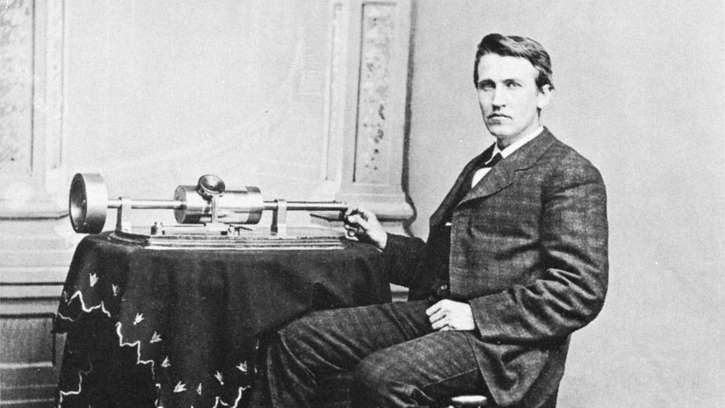
Minds Behind the Machines: Thomas Edison
Thomas Edison (1847-1931) stands as one of history's most prolific inventors, holding 1,093 patents in the United States alone. Known as the "Wizard of Menlo Park," Edison's innovations fundamentally transformed modern civilization, touching everything from how we illuminate our homes to how we record sound.
The Phonograph: Capturing Time
Edison's invention of the phonograph in 1877 seemed like magic to his contemporaries. The ability to record and reproduce human speech was so revolutionary that many dismissed early demonstrations as tricks. When Edison first recited "Mary Had a Little Lamb" into his tinfoil-wrapped cylinder device, he created something unprecedented—a machine that could capture time itself.
The phonograph emerged from Edison's work on telegraph and telephone improvements, demonstrating his ability to see connections between technologies. The device used a simple but ingenious mechanism: a stylus that both recorded and played back sound vibrations on a rotating cylinder. For the first time in history, voices could be preserved and transmitted across time and space.
Illuminating the World
Edison's improvements to the incandescent light bulb transformed civilization as profoundly as fire. While he didn't invent the first electric light, Edison created the first practical, long-lasting bulb with a carbon filament that burned for over 1,200 hours—a dramatic improvement over existing designs that lasted mere minutes.
Edison's true genius lay in recognizing that the light bulb was useless without electrical infrastructure. He didn't just invent better lighting—he created the world's first comprehensive electrical power distribution system, including generators, transmission lines, and safety devices.
In 1882, Edison's Pearl Street Station in Manhattan became the world's first central power plant, serving 85 customers with 400 electric lamps. This marked the beginning of the electrical age, as Edison solved not just technical challenges but also economic and logistical problems of bringing electricity to the masses.
The Innovation Factory
Perhaps Edison's greatest invention was his approach to invention itself. At Menlo Park, New Jersey, he created the world's first industrial research laboratory, employing teams of skilled technicians and engineers. This "invention factory" produced a minor invention every ten days and a major breakthrough every six months.
Edison's systematic approach included meticulous documentation, rapid prototyping, and exhaustive testing. He famously tested over 3,000 materials for light bulb filaments before settling on carbonized bamboo. This methodical persistence embodied his famous declaration: "Genius is one percent inspiration and ninety-nine percent perspiration."
Complete Technological Systems
What distinguished Edison was his ability to envision complete technological systems rather than isolated devices. His work in electrical power laid the foundation for modern industry. His telegraph improvements and telephone switchboard development revolutionized communications. His motion picture camera launched the entertainment industry.
Edison understood that successful innovation required not just initial breakthroughs but also infrastructure, manufacturing processes, and business models to bring inventions to market.
Legacy of Systematic Innovation
Edison's approach—systematic experimentation, team-based research, and comprehensive system thinking—continues influencing technological development today. His Menlo Park laboratory became the model for corporate research facilities worldwide, from Bell Labs to Silicon Valley companies.
Edison demonstrated that innovation could be both systematic and prolific. His legacy shows us that transformative technologies emerge from disciplined methodology, sustained effort, and vision to connect disparate ideas. In our age of rapid technological change, Edison's example remains relevant, proving that profound innovations result from marrying inspiration with systematic hard work.